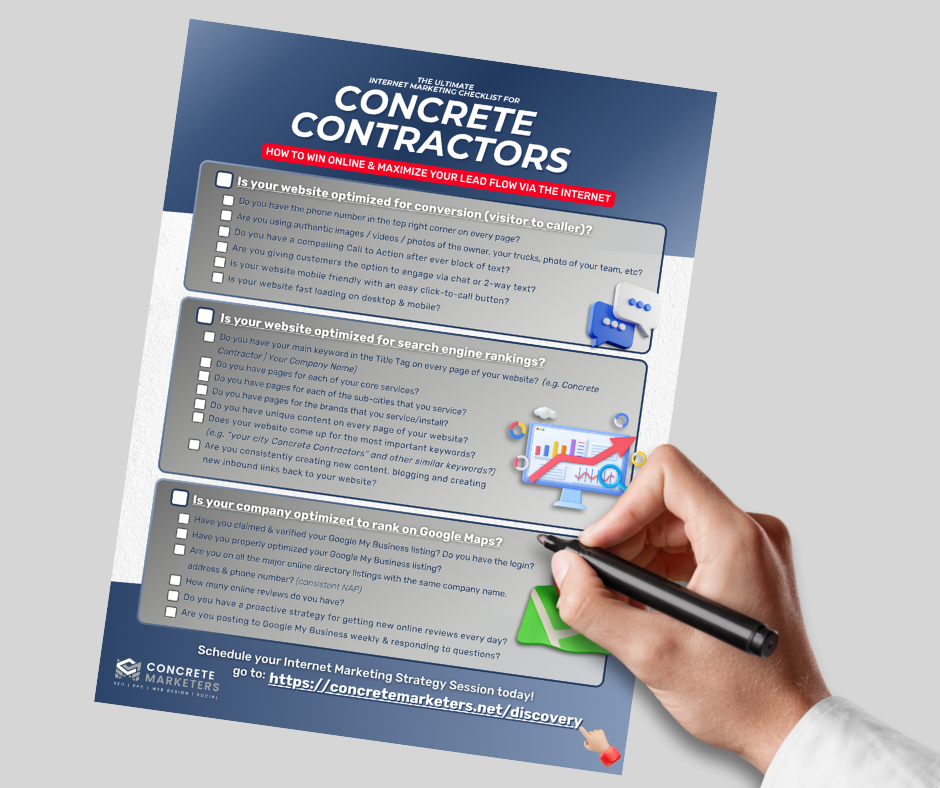
For most concrete contractors, Google Maps is the single most valuable piece of online real estate they own.
When a homeowner pulls out their phone and types “concrete contractor near me” or “stamped concrete patio [city],” one of the first things they see is the Google Maps result.
Three contractors, three pins, three sets of reviews. For most local searches, this is where most homeowner makes their pick.
If your concrete business isn’t in those top three results, you’re losing jobs every week to the contractors who are.
The good news: Google Maps rankings aren’t random. There’s a specific formula behind which concrete contractors show up at the top, and it’s something you can absolutely influence.
The bad news: most concrete contractors are doing things that actively hurt their rankings without realising it.
This post breaks down exactly how to get into the top three and stay there. The five mistakes hurting most concrete contractors’ rankings, the three-pillar formula for getting found, and the bonus moves that put you ahead of competitors who don’t bother.
Do Google Maps Still Matter?
Quick yes, with the data behind it.
The latest research shows around 71% of clicks on a Google search page go to either the map results or the organic listings underneath, not the paid ads. And 67% of all clicks go to just the top five listings (the three map results plus the top two organic).
For concrete contractors, that means the map is where the lion’s share of free, high-intent traffic comes from. Someone searching “concrete driveway contractor near me” isn’t a tyre-kicker. They’re a homeowner who has decided they want the work done. The contractor who shows up first in the map gets the call.
AI tools like ChatGPT and Gemini are starting to take a small share of these searches, but for local service queries, Google still dominates by a massive margin. The volume of “near me” plumber, concrete, electrician, and HVAC searches on Google is exponentially higher than what happens on AI engines today. That’s worth keeping an eye on for the future, but for right now, Google Maps is still where the money is.
Why This Matters Even More for Concrete Contractors
Concrete is a local, high-trust trade. A homeowner researching a $7,000 polyaspartic garage coating or a $12,000 stamped concrete patio isn’t going to hire someone they’ve never heard of without doing their homework.
What does that homework look like? They open Google Maps, they look at who shows up in the top three, they read the reviews, they check the photos, and they pick the one that feels most legitimate. Proximity matters. Reviews matter. Whether your photos look like a real concrete crew or a stock image matters.
Showing up in the top three of Google Maps isn’t an ego ranking. It’s the difference between getting a steady stream of high-ticket concrete jobs and watching your competitor get them instead.
The Five Mistakes Hurting Most Concrete Contractors’ Map Rankings
Before we get to the formula for ranking, here are the things that are actively stopping concrete contractors from ranking. Fix these first.
1. Wrong Address (Or No Address in the City You Want to Rank In)
To rank on Google Maps in a specific city, you need a real, physical business address in that city.
A UPS store mailbox won’t work. A virtual office usually won’t either. Google has gotten very good at spotting these and either suppresses the listing or refuses to verify it.
Here’s a common scenario for concrete contractors: your business is based in a small suburb, but the bigger city next door is where most of the search volume is. You want to rank in the big city. Without a real address there, you’re fighting a losing battle. Your map listing in the suburb might rank fine, but trying to rank in the city next door without a physical presence is nearly impossible.
The fix is either accepting that you’ll rank where you actually are (and building visibility through other channels in the bigger city), or establishing a legitimate physical presence in the target city.
2. Spammed Locations from the Past
Years ago, a common trick was to set up multiple fake addresses across different cities to rank in all of them. Some marketing agencies recommended this. Some concrete contractors did it themselves.
Google has cracked down on this hard. Fake listings get caught, get suspended, and worst of all, they can drag down your main, legitimate listing’s authority. We’ve seen concrete contractors who can’t figure out why their main location dropped off the map, and the answer is usually old fake listings still floating around connected to their business.
The fix is finding those old listings, reporting them as closed or permanently removed, and rebuilding your authority around your one legitimate location.
3. Inconsistent Name, Address, and Phone (NAP)
If your business name is “ABC Concrete LLC” on Google, “ABC Concrete” on Yelp, “ABC Concrete and Coatings” on Houzz, and “A.B.C. Concrete” on BBB, that inconsistency hurts you.
Google looks across the web to verify your business is legitimate. When the same business shows up with the same name, address, and phone in lots of places consistently, that’s a strong signal of authority. When the details vary, the signal weakens.
Even small variations matter. “Street” vs “St”, different suite numbers, an old phone number that’s still listed somewhere. All of it adds up. Most concrete contractors have this problem and don’t realise it because the listings were created at different times by different people.
4. Spammed Business Name or Categories
Two related mistakes:
- Stuffing your business name with extra keywords. “ABC Concrete Stamped Patios Driveway Coatings Phoenix” is not your business name. Google knows this and will penalise it.
- Selecting irrelevant categories to try to rank for more types of searches. Picking “general contractor” when you only do concrete, or “landscaping” because you do some hardscaping, dilutes your relevance and can hurt your rankings.
The rule: list your business exactly as it is. Pick the categories that genuinely match what you do. Concrete contractor, decorative concrete contractor, paving contractor, whatever actually applies. Don’t game it.
5. Not Enough Reviews
This is the single biggest factor we see holding concrete contractors back from top-three rankings.
All else equal, the concrete contractor with the most legitimate reviews wins. And it’s not just the total count. Google looks at:
- Velocity. Are reviews coming in consistently over time, or did you get 40 in one week and nothing since?
- Sentiment. What’s your average star rating? 4.5+ is the benchmark.
- Response. Are you replying to reviews, both positive and negative?
- Recency. When was your last review? Three years ago is a red flag.
If your three biggest competitors have 200+ reviews and you have 27, that gap alone is enough to keep you out of the top three. Fixing this is non-negotiable.
The Three-Pillar Maps Ranking Formula
Now the formula for actually ranking. Three pillars, all of which need to be working together.
Pillar 1: Claim and Optimise Your Google Business Profile
This is the foundation. Get it right and everything else has a chance to work.
The non-negotiables:
- Claim your Google Business Profile. If you haven’t already, do this today. Verify it properly. Video verification is the strongest method available right now, especially if you’ve struggled to verify in the past.
- Get the business name, address, and phone number exactly right. Match exactly what’s on your website, your invoices, and your business registration. No variations.
- Pick the right categories. Your primary category should be your most relevant (usually “Concrete Contractor”). Add secondary categories for specialities like decorative concrete contractor, paving contractor, etc.
- Use a local phone number. A 1-800 number kills your local relevance signals. Use a number with your local area code.
- Upload real photos. Your team, your trucks, your finished driveways, patios, garage coatings, and decorative work. Stock photos are worthless here. Real photos taken from a phone consistently outperform polished agency shots.
- Write a detailed business description. Use it to clearly state what you do, where you serve, and what makes you different. Include your main keywords naturally, but write for the customer, not the algorithm.
- Fill in everything. Hours, services, attributes, payment methods, service area. Every field you complete is another signal of legitimacy.
Then keep it active:
- Upload new photos regularly. A finished project from last week. A truck on a job site. A team photo. Active listings outrank dormant ones.
- Use Google Posts. Special offers, seasonal reminders (“Now booking spring driveway pours”), project highlights. Posts signal an active business.
- Answer every review. Thank the positive ones, address the negative ones calmly and professionally. Google watches this.
- Answer Q&A. If questions appear on your profile, answer them. Better, pre-seed common questions yourself and answer them. (“Do you do polyaspartic garage coatings?” “Yes, polyaspartic is one of our specialities…”)
Pillar 2: Build Citations Across the Web
Citations are mentions of your business name, address, and phone number on other websites. They tell Google your business is legitimate and well-established.
The key isn’t just quantity, it’s consistency. Every citation needs to show the same name, address, and phone exactly as it appears on your Google Business Profile.
Where to focus:
- The four data aggregators. Factual, Acxiom, Infogroup, and Neustar feed data to thousands of smaller directories across the web. Getting your information right at these four sources cascades out across the internet.
- The major directories. Yelp, BBB, Houzz, Angi, Yellow Pages, Facebook, BING Places, Apple Maps.
- Industry-specific directories. Concrete contractor associations, decorative concrete networks, local builder directories.
- Local directories. Your local Chamber of Commerce, “[city] business directory” type sites, regional trade groups.
The mistake most concrete contractors make is trying to fix citations one at a time on individual sites. The information often gets overwritten because the smaller sites pull from the data aggregators. You have to fix the source, not just the symptoms.
Tools that help with this include Yext (which has direct feeds into many of the major sources), BrightLocal, and Whitespark. Done properly, this is usually a one-time setup with periodic maintenance, but it pays off in rankings for years.
Pillar 3: Drive Online Reviews
The third pillar is the one most concrete contractors underuse. Reviews drive rankings, and active review generation is the difference between ranking 7th and ranking 1st.
The system that works:
- Automate the review request. The moment a job is marked complete in your dispatch system, an automated text and email should go out to the customer asking for a review with a direct link to your Google profile. Don’t rely on the crew to remember.
- Make it easy. One click should take the customer straight to the review page. Any extra friction kills response rates.
- Train the crew to plant the seed. “Hey, if you’re happy with the work, we’d really appreciate a quick review when you get the email.” That single sentence dramatically lifts review response rates.
- Spread reviews across platforms. Don’t put all your eggs in Google. Yelp, Houzz, BBB, Facebook reviews all matter, both for Google’s ranking signals and for the homeowners who check multiple platforms.
- Respond to every review. Thank reviewers by name. Reference the specific work (driveway, patio, coating). Respond to negative reviews professionally, never defensively.
Consistent review generation over time creates the velocity, sentiment, and total count Google rewards. A concrete contractor getting 8 to 12 reviews a month will eventually overtake competitors who only get reviews occasionally, and stay ahead.
The Bonus Pillar: On-Page Optimisation
Your website matters for map rankings too. Google looks at your site to verify what you do, where you serve, and how legitimate you are.
The basics that move the needle:
- A unique service page for every service you offer. Stamped concrete, decorative concrete, polished floors, driveways, patios, coatings, repairs. Each gets its own dedicated page.
- A unique page for every city you serve. If you cover ten towns, you need ten city pages, each with genuinely unique content about that area.
- Schema markup. The behind-the-scenes code that tells Google what your business is, what you do, and where you serve. Local business schema is non-negotiable.
- Keyword alignment. The keywords on your website should match what your customers actually search. “Stamped concrete patio cost,” “epoxy garage floor [city],” etc.
A properly optimised website is the partner to your Google Business Profile. The two work together to tell Google a consistent, authoritative story about your concrete business.
Link Building for Map Rankings
The last piece, and one most concrete contractors completely ignore, is local link building.
Links from other relevant local websites pass authority to your business and lift your map rankings. The opportunities that work especially well for concrete contractors:
- Local sponsorships. Sponsor a Little League team, a charity event, a community fundraiser. Many of these organisations have websites that will link to sponsors. That single backlink from a relevant local site is worth more than dozens of generic links.
- Community resource pages. Some local sites maintain “trusted local businesses” lists. Get on them.
- Reciprocal links with related trades. Landscapers, pool builders, custom home builders. Businesses that complement (not compete with) concrete work. Cross-link with each other’s websites and refer business back and forth.
- Local press and news features. Got featured on a regional publication? That’s a serious authority boost.
Done consistently, this kind of local link building gives you a defensible edge over competitors who never bother.
The Opportunity for Concrete Contractors Right Now
Most concrete contractors aren’t doing any of this properly. They’ve claimed their Google Business Profile (maybe), they’ve got 30 reviews (maybe), and that’s about it.
That’s the opportunity. Even basic claim-and-optimise puts you ahead of 70% of concrete contractors in most markets. Layer in proper citation building, consistent review generation, and local link building, and you can own the top three spots on Google Maps in your area, and own them for years.
Map rankings compound. Every month you stay on top, more reviews come in, more homeowners click through, more jobs get booked. And every booked job is another opportunity for another review, which makes your rankings stronger, which means more clicks next month.
The concrete contractors who set this up properly in 2026 are going to be the ones owning their local markets in 2030.
Want to know exactly why your concrete business isn’t ranking in the top 3 on Google Maps?
We’ll run a full audit of your current marketing strategy, pinpoint where the biggest ranking opportunities are hiding, and benchmark you directly against your top competitors so you know exactly what they’re doing that you aren’t.
A few hours of our team’s time. Nothing on your end.